From Punch Cards to Phone Numbers: American Loyalty Compared With Japan
Why does ‘nine drinks, then one free’ survive the move from paper to apps? A practical comparison of London loyalty cards and Japan’s shared-point culture.

From Punch Cards to Phone Numbers: American Loyalty Compared With Japan
Brief
- Reader: Independent shop owners interested in stamp cards and loyalty programs
- Problem or question: How are American stamp cards different from Japanese ones, and how have they changed from paper to today's systems?
- Promise: Compare American trading stamps, punch cards, POS loyalty, and brand apps with Japanese shop cards, shared points, and LINE
- Why KAIJU STAMPS can speak credibly: Its founder previously ran a café and is building a way to digitize paper stamp cards without a dedicated customer app or account
- Desired next action: Review what customers must do to begin using your card
Outline
- Americans usually say “punch card,” not “stamp card”
- Traditional loyalty ranged from trading stamps to simple shop punch cards
- Recent programs use phone numbers, POS systems, apps, and subscriptions
- Japan combines shop-specific cards with shared points and LINE
- Four useful differences between the markets
- Lessons for independent shops
Draft
When I see a small card beside the till in another country, I cannot help picking it up.
Buy one coffee, get one hole. Fill ten spaces, receive a free drink. At first glance, it looks almost identical to a Japanese stamp card.
Look more broadly at the United States, however, and a different picture appears.
Paper cards are often punched rather than stamped. Supermarkets and restaurant chains may look up members by phone number. Large brand apps combine points with ordering, payment, status, and subscriptions.
This article looks at American stamp and shop card culture and compares it with Japan.
The short version is that American loyalty has shifted its center of gravity from a paper card for one shop toward systems that identify the member. Japan, by contrast, combines shop-specific cards with shared points used across companies and cards inside an existing platform such as LINE.
Neither approach is automatically better. They create different relationships between a customer and a shop.
Americans usually say “punch card”
There is a language difference before there is a technology difference.
What Japan calls a stamp card is often called a punch card or loyalty card in the United States. Some shops use ink stamps, but the familiar practice of marking the card with a handheld hole punch remains in the name.
“Shop card” is less likely to communicate the Japanese meaning. Depending on the context, an English speaker may think of a gift card, store card, or retailer-issued credit card.
If you are looking for examples in the US, searches such as coffee punch card, loyalty card, and rewards program are more likely to find the right thing.
Traditional America: collect stamps, then redeem them outside the shop
One important part of American loyalty history is S&H Green Stamps.
Customers received small green stamps when they shopped at participating businesses. They pasted the stamps into booklets and exchanged completed books for merchandise. It was a modern points program operated with paper and glue.
S&H began in 1896 and spread through supermarkets, gas stations, and other retailers. In 1964, more than 60% of American consumers saved S&H Green Stamps, according to a US Supreme Court decision that described the business.
The reward did not necessarily come from the shop where the customer received the stamp.
Stamps from participating retailers could be combined and exchanged at a redemption center for household goods. The program connected everyday spending to a larger reward rather than only deepening a one-to-one relationship with one shop. A Smithsonian Magazine feature describes the program at its peak.
Small cafés, bakeries, and sandwich shops kept a simpler punch-card model.
One purchase creates one hole. A completed card earns a free item or discount. The rule is easy to explain at the till, and the card can start immediately without asking for a name or phone number.
Japan followed a surprisingly similar path. Shop-specific stamp cards expanded into shared stamp programs such as Green Stamp and Blue Chip, as described in a National Tax College history.
American and Japanese paper loyalty grew in different settings, but their histories have closely related branches.
America now: the system looks up the member instead of the member carrying a card
The recent change is not only that paper became a screen.
The larger change is that a system can identify the member even when there is no card to show.
1. Phone numbers and POS loyalty reach small shops
With Square Loyalty in the United States, customers can enroll at checkout with a mobile phone number. Their points remain connected to that number.
The seller can award points according to visits, spending, or specific items. Customers check in with their phone number and can view or redeem earned rewards. Square's official help also describes adding a loyalty pass to an iPhone wallet.
Compared with paper, this makes the card harder to forget and lets the business manage payment and loyalty through related systems.
The trade-off is that a phone number is required at enrollment. A relationship that could begin anonymously with paper becomes one in which the system needs to distinguish one member from another.
2. A brand app becomes the entry point for the whole visit
Starbucks Rewards members collect Stars through eligible purchases and activities, then exchange them for benefits. The current US program includes membership status, while the app offers member-only challenges and offers. The official Rewards page places loyalty, ordering, and payment in one experience.
In 2026, Starbucks also announced scheduled mobile ordering at participating North American stores. Its announcement explains how customers build an order, select a collection time, and pay in the app.
At that point, the digital card is no longer a paper card placed on a phone.
Membership, ordering ahead, payment, benefits, and personalized offers form an entry point that starts before the visit and continues afterward.
3. The reward can become a paid habit instead of a future free item
Subscriptions are another visible American model.
Panera Bread's Sip Club is a paid beverage program for MyPanera members. Benefits live in the MyPanera account and can be accessed in store with a member card, phone number, or account. The official information explains those redemption options.
A traditional punch card records past purchases and eventually makes a future drink free.
A subscription begins with membership and aims to make the period of membership more useful. Both create a reason to return, but they point in opposite directions through time.
4. Digital options did not make cash and paper disappear overnight
Not every American till has become app-only.
The Federal Reserve Financial Services' 2026 research found that credit and debit cards accounted for two-thirds of payments, while roughly one in seven payments was still made in cash. Four out of five consumers had used cash during the previous 30 days. See the 2026 Diary of Consumer Payment Choice.
That is payment research, not loyalty research. It still illustrates a useful point: consumer habits change slowly, and old and new methods can coexist for a long time.
The same is true of punch cards. More digital options do not remove the value of paper's clarity.
Japan: shop cards and “points you can use almost anywhere” overlap
Japan also moved from shop-specific paper cards toward digital systems. Compared with the United States, however, shared points used across companies and industries have a particularly visible role.
Rakuten Points can be earned and spent at convenience stores, gas stations, and other participating businesses, as well as across Rakuten group services. The official guide explains how customers present a plastic card or app barcode before payment.
The value sits in a different place from a punch card for one café.
- A punch card says: the more often you return here, the closer you get to a reward.
- Shared points say: everyday spending in many places can accumulate into one balance.
LINE Shop Card gives Japanese small businesses another option. A business can place its card inside an app customers already use instead of building a dedicated app from scratch. The LINE Official Account help center describes awarding points when a customer scans a QR code.
An American Square-style program often begins with the POS and a phone number. A Japanese LINE card begins inside a familiar messaging app.
“Open the app you already use” and “enter your phone number at the till” are two different ways to reduce the need for another physical card.
Four differences that stand out
Representative examples can be compared through four questions.
What is the paper card called?
In the United States, “punch card” is common, preserving the image of marking each purchase with a hole.
In Japan, terms that translate as stamp card, point card, and shop card are used according to the business and program.
How is the member identified?
American programs often use a phone number, POS account, or proprietary brand app to find the customer's points.
Japanese programs use physical cards, shared-point IDs, LINE, and brand apps as membership credentials.
How far do the benefits extend?
American programs include free products and discounts within a shop or chain, as well as tiers and paid subscriptions.
Japan has those shop benefits too, alongside shared points that can be earned and spent across different companies.
Where does digitization begin?
In the United States, loyalty is often integrated into the POS and offered during checkout through a phone number.
In Japan, businesses can also use existing shared-point systems or a messaging platform such as LINE, placing a new card inside a service customers already use.
There is no single correct national model.
America has shared programs, and Japan has shops that use phone numbers and proprietary apps. The useful comparison is not national character. It is where representative services place the entry point at the counter.
What really changed between traditional and recent cards
The move from paper to digital cannot be reduced to “more convenient.”
What changed is where the effort and information sit.
- A paper punch card starts quickly but can be lost or forgotten.
- Phone-number POS loyalty removes the card but requires identification.
- A brand app can combine ordering and payment but requires a download and account.
- An existing platform reduces new apps but depends on the customer using that service.
- A wallet or browser reduces the need for a dedicated app but still needs a clear saving flow at the counter.
Digitisation does not eliminate the work. It moves the work between the shop, the customer, and the system.
The right choice depends on what a shop actually needs.
If purchase-history offers matter, customer identification serves a purpose. If ordering and payment need to be integrated, an app can serve a purpose.
If the only promise is “three more visits and your next coffee is free,” the shop may not need to collect much information at all.
What independent shops can learn
Three lessons stand out.
Make the rule explainable in one breath
“Buy nine, get the next one free.”
That clarity works on paper and on a screen. The more multipliers, tiers, exclusions, and expiry conditions you add, the more staff have to explain. Start by asking whether a customer can hear the rule once and remember it.
Decide what the first stamp asks in return
A phone number. An email address. An app. An account. Payment details.
Each may serve a purpose. Without one, it may simply add hesitation for a first-time customer.
Paper was strong because it began the moment the customer accepted it. A digital card should also keep the distance to the first stamp short.
Choose the “thank you” before choosing the data
S&H Green Stamps connected everyday spending to a large merchandise reward. Punch cards connect repeat visits to a free item. Shared points let value travel between businesses. A subscription makes the habit itself part of membership.
All of them are loyalty.
An independent shop does not need to reproduce every feature of a national chain. Once it decides what it wants to give back to regulars, it becomes easier to choose between paper, POS, an app, and a wallet.
The card shows what a shop means by “regular”
American loyalty has moved from stamps pasted into a booklet through punch cards, phone-number POS systems, brand apps, and subscriptions. Those approaches now overlap.
Japan has shop-specific stamps, shared points, LINE, and proprietary apps living side by side.
In both countries, a card is more than a discount.
How does the shop remember someone who returned?
What does it give back as a thank you?
The shape of the card reflects the answer.
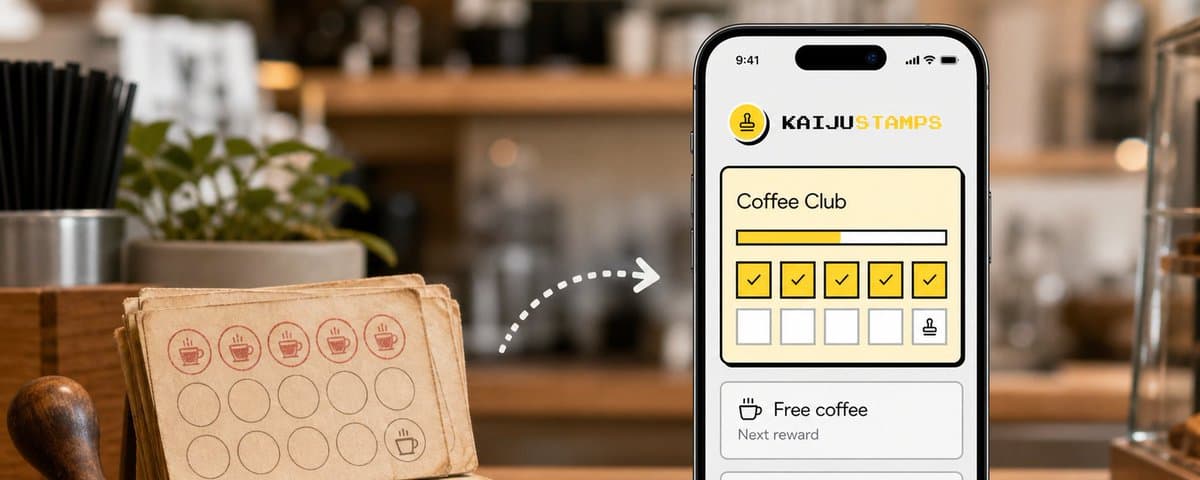
KAIJU STAMPS is one option. It keeps the clarity of paper while letting customers save the card to Apple Wallet, Google Wallet, or a browser. Customers do not need a dedicated app or KAIJU STAMPS account.
Before reviewing features, ask one question:
What do customers have to do before receiving their first stamp?
The answer can help reveal which system fits the shop.